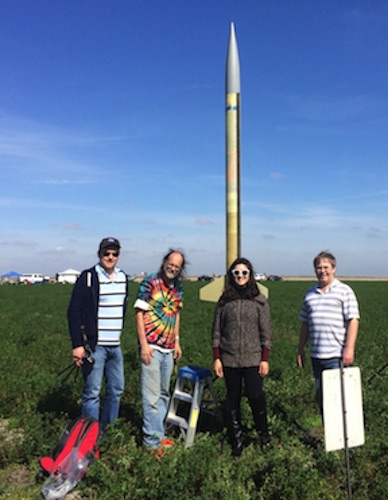
ERPS members fly the KISS Beta test vehicle at Fresno Tripoli HPR meet.

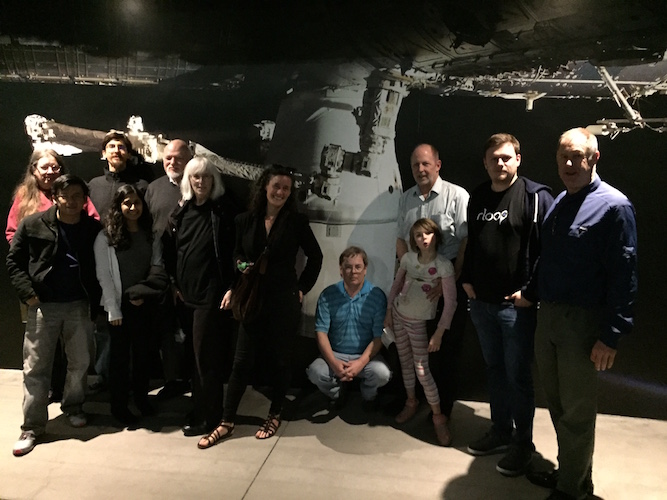
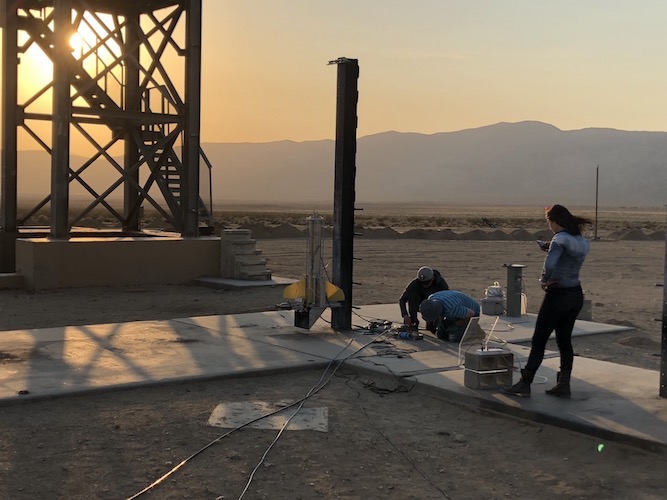
In the beginning…
The E.R.P.S. was founded in February of 1993 to gather interested amateurs in a group that would learn about, design, build, and test liquid fuel rocket engines. Its founders, Michael Wallis and Kevin Bollinger, hoped to foster and disseminate “nuts and bolts” knowledge of rocket science, and thereby speed the day when truly routine access to space would be achieved.
Early on, the group decided to concentrate on developing and testing high density, room-temperature-storable propellant combinations. The reason was because they allowed the maximum amount of work to be done with the minimum amount of risk to life, limb and logistics. After research and consultations, high-purity Hydrogen Peroxide (H2O2) was selected as the oxidizer of choice, with the intent to use it with a high-density kerosene such as JP5 or regular Jet-A. In the meantime, the H2O2 (also known as HTP, or “high-test peroxide”) could serve as a monopropellant, permitting the group to “cut its teeth” on relatively safe rockets with reasonable performance.
Over the next eleven years, the group acquired access to rocket-engine assembly and test facilities and, more important, active members with the skills to make good use of those facilities. We’ve achieved a number of successes — notably, the first repeated amateur launch of the same vehicle within one 24-hour period.
Where we’re headed …
The group was founded to pursue the development of technology capable of reaching Low Earth Orbit (LEO) in a single stage. That goal has not changed, even though it’s taking longer to get there than we expected. The keys to this achievement are lots of building and testing.
Since beginning with HTP in mono-propellant vehicles made logistical sense, best performance demanded concentrations of 95% and higher. Therefore the E.R.P.S. set out to find, by research, test and experimentation, a catalyst formulation that could operate with 95% to 100% peroxide without deteriorating. Such a catalyst would be of great value in the efforts to open the space frontier. We believe we have such a catalyst, but we need to run more tests to make sure. We expect to complete those tests later this year.
Getting to the next level of performance (and, ultimately, LEO) will require a bi-propellant vehicle — which adds a whole new order of complexity.
Vehicle control is another challenge. We have a team working on control issues. Their primary tool at present is a home-brew propellor-driven testbed called “Gizmocopter”. The idea is that control software can be developed on Gizmo, with testing done locally, and later transferred relatively quickly to a multi-engine rocket vehicle. This team is also responsible for the electronics on our existing rockets.
Our other challenges include logistics (keeping track of parts, tools, etc.), documentation (too often overlooked, but essential to a successful development effort), safety, and regulatory affairs.
To sum up, we are designing and building a series of increasingly capable vehicles, the last of which will reach low Earth orbit. If you’re interested in helping us reach that goal, read through the Web site to find out what we’ve doing in more detail. Then show up at a general meeting and volunteer for a job where you think you can make a contribution.
Board and Officers
The ERPS is directed by a board chosen from the executive membership. Director elections are held in May of each year, at the annual meeting, and serve for 2 years.
Members of the Board of Directors serve 2-year terms, the year appearing is the year they were elected:
- Michael Wallis (2025) Chairman
- Gerald D. Nordley (2025)
- Dan Solvin (2025)
- Julie Porter (2024)
- Rick Kwan (2024)
Officer elections are also held at the annual meeting, but serve for 1 year.
The current (2025-2026) slate of officers is:
| President | Michael Wallis |
|---|---|
| Vice President | Alex Mikhailov |
| Treasurer | Gerald D. Nordley |
| Secretary | Rick Kwan |
Joining ERPS
There are three classes of membership in ERPS: Observer, Participating, and Executive.
- Observer — This class of membership is mostly for those who reside outside the San Francisco Bay area. It permits you to read and post to the mailing list. Those who live locally can also attend the monthly General Meetings — but so can the general public.
- Participating — Participating members pay a $25 annual fee that supports the activities and efforts of the group. This also allows you to participate in development teams, attend rocket tests, participate in project meetings and more. This is the “hands-on” level of ERPS membership.
- Executive — Executive members make up the core of ERPS leadership, by serving as Project Leads, Officers or Directors for the group.
We provide a printable ERPS Membership Application Form on-line for people. Simply fill in the requested fields, print a copy, and mail it to the address indicated. (If you live nearby, you can bring it to any General Meeting.)
E-mail List
The membership of ERPS is worldwide. These far-flung members keep in touch chiefly by participating in the Society’s electronic mailing list. Instructions for signing up, as well as an archive of past messages, are found HERE.
Contact Information
Because of the voluntary nature of the group, there is no ERPS office, no full-time (or even part-time) staff to answer questions in real time, etc. (We do maintain a post office box, but it’s mostly for Invoices from suppliers.)
E.R.P.S.
PO Box 61642,
Sunnyvale, CA 94088-1642
The Internet lets us maintain contact among members, keep track of progress, notify people in the local area of meetings, and receive valuable help from more distant contributors. The main avenue for this communication is the ERPS e-mail list. Instructions for subscribing to the list and archives of past posts are available on the list info page.
Regular Meetings
Regular meetings during the Covid-19 pandemic are being held online using Zoom at 7:30 PM Pacific time on the third Tuesday of the month.
We are now meeting in person again at Maker Nexus, 1330 Orleans Drive, Sunnyvale, CA. If you can make it, please join us. If not, please consider joining the virtual meeting over Zoom.
Join Our Zoom Meeting
https://zoom.us/j/92433657370?pwd=ekpRUng4M0tjMDhjTk9FODlUV3l3QT09
Meeting ID: 924 3365 7370
Password: 4J6TQp